Our digital tools provide measurable practice and diagnostic feedback—but the best knowledge is visible. That’s why we package our essential reference materials (Circle of Fifths, Fretboard Guides) into our complimentary Mastery Kit. Stop wasting time looking up notes; have an entire theoretical framework available right on your wall.”
Blog
-

Free interactive tools Sight-reading trainer
-
Scale of the week
D Dorian
The minor scale with a raised sixth
Dorian is the minor scale most jazz players reach for first. It sounds minor, but the raised sixth keeps it brighter than the natural minor, which is why it fits so many ii chords.
- Notes in D: D E F G A B C
- Formula: 1 2 b3 4 5 6 b7
- Chords it suits: m7, m6 (the ii chord in a major key, and minor tonic chords)
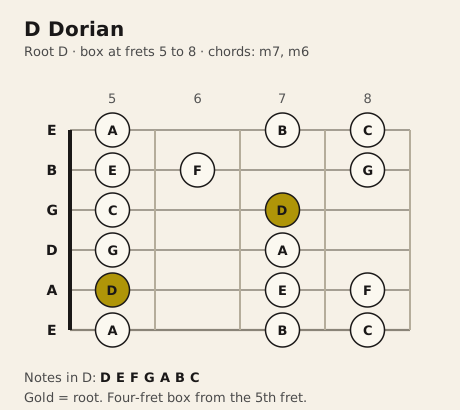
D Dorian scale on guitar How to think about it
Play Dorian over a Dm7 chord and it sits in the chord with no clash. The colour note is the B, the raised sixth. Over a plain minor chord the B sounds bright and lifted; the natural minor sixth, B♭, sounds darker. Listen for that one note. Dorian is also the second mode of C major, so if you already know the C major scale, start on D and play through it. The notes are the same; only the home note changes.
Exercises
- Root to octave. Play the D Dorian scale up and down from the 5th fret, one octave, at a slow tempo. Say each note name out loud as you play it.
- Dm7 to D Dorian. Play a Dm7 chord, then play the D Dorian scale over it, ending on D. Listen for whether the scale and the chord agree. Then try ending on the B. Which note sounds more finished?
- Three-note cells. Take the first three notes of the scale (D E F), then move them up one note at a time through the scale. Keep the rhythm steady. Use a backing track in D minor if you have one.
Listen first. Hold a D drone and play the scale. Listen for the B: it should sound bright, not sad. Then play the B♭ and hear the difference.
Next week: E Phrygian, the dark one.