
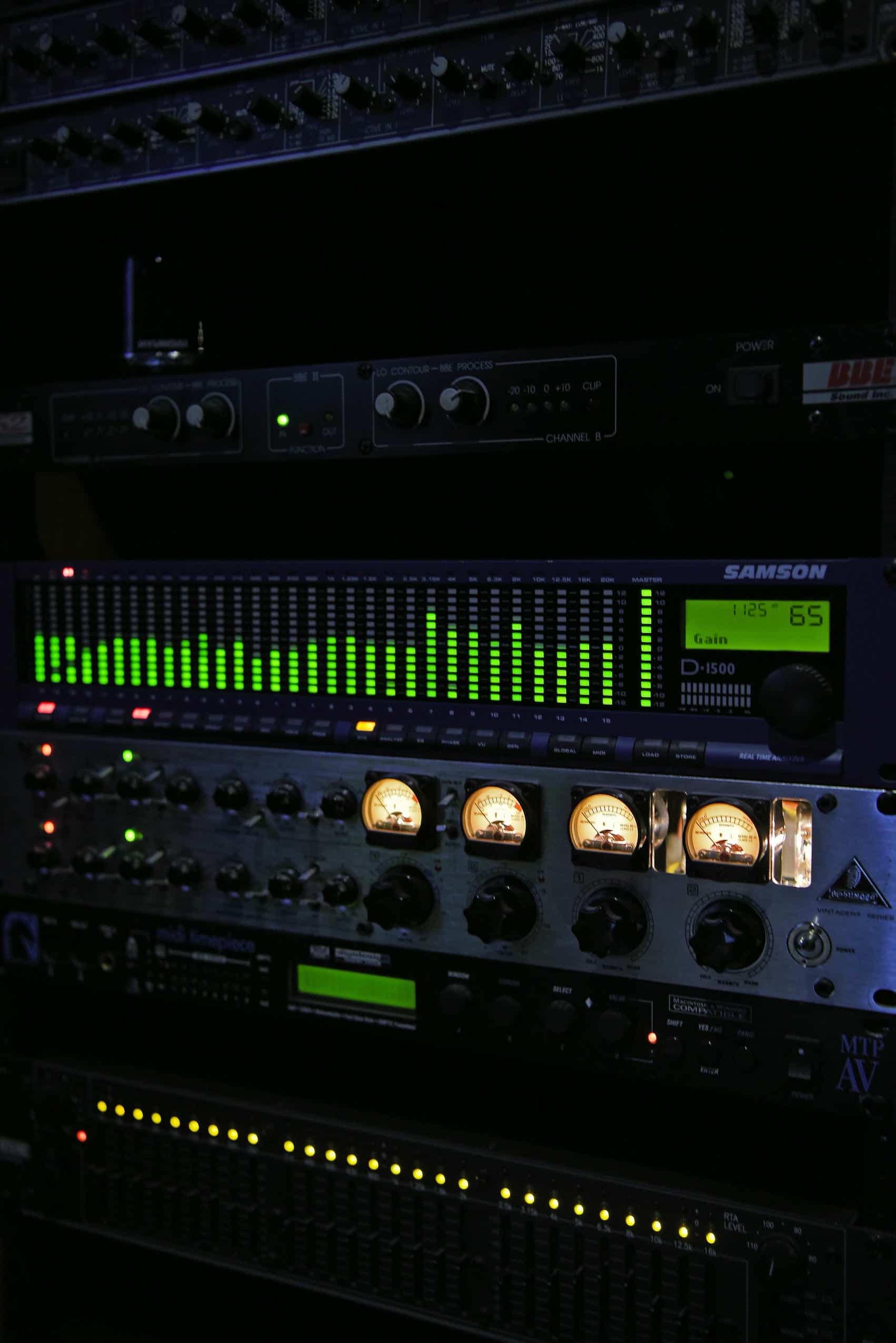
Digital Filters
An essential tool in signal processing and image analysis, used to modify or enhance signals by removing unwanted components.
There are several types of digital filters, including:
-
Low-pass filter (LPF): Allows low-frequency components to pass through while attenuating high-frequency ones.
-
High-pass filter (HPF): Does the opposite of a LPF; it allows high-frequency components to pass through while suppressing low-frequency ones.
-
Band-pass filter (BPF): Passes frequencies within a specific range, rejecting both lower and higher frequency ranges.
-
Notch filter: A type of BPF that rejects a narrow band of frequencies.
Digital filters can be implemented using various techniques:
-
Finite Impulse Response (FIR) filters: These are simple to implement but may not provide the desired level of filtering due to their limited number of coefficients.
-
Infinite Impulse Response (IIR) filters: More complex than FIRs, IIRs can achieve better performance with fewer coefficients.
Some common applications for digital filters include:
-
Noise reduction: Removing unwanted noise from audio or image signals.
-
Image processing: Enhancing images by removing artifacts or improving contrast.
-
Audio equalization: Adjusting the tone of music to suit individual preferences.
-
Signal conditioning: Preparing signals for further analysis or processing.
Digital audio filters
Digital audio filters are a crucial part of audio signal processing, used to modify the tone and quality of music. Here are some key aspects:
Types of Digital Audio Filters
-
Low-pass filter (LPF): Reduces high-frequency components, making the sound warmer or more mellow.
-
High-pass filter (HPF): Increases high-frequency components, adding brightness or clarity to the sound.
-
Band-pass filter (BPF): Passes a specific range of frequencies while rejecting others, often used for EQing individual instruments.
-
Notch filter: A type of BPF that rejects a narrow band of frequencies, useful for removing unwanted resonances.
Digital Audio Filter Implementations
-
Finite Impulse Response (FIR) filters: Simple to implement and computationally efficient but may not provide the desired level of filtering.
-
Infinite Impulse Response (IIR) filters: More complex than FIRs, IIRs can achieve better performance with fewer coefficients.
Digital Audio Filter Applications
-
Equalization (EQ): Adjusting the tone of music to suit individual preferences by boosting or cutting specific frequency ranges.
-
Noise reduction: Removing unwanted noise from audio signals using filters like LPFs or HPFs.
-
Audio compression: Reducing dynamic range and loudness while preserving overall sound quality.
Digital Audio Filter Parameters:
-
Cutoff frequency (FC): The point at which the filter starts to attenuate frequencies above a certain value.
-
Slope (or Q-factor): A measure of how steeply the filter rolls off or boosts frequencies around the cutoff point.
-
Gain: An adjustment factor that can be applied to the filtered signal.
Digital Audio Filter Algorithms and Techniques
-
Fast Fourier Transform (FFT) analysis: Breaking down audio signals into their frequency components for precise filtering.
-
Convolution-based filters: Using a “kernel” or impulse response to modify audio signals in real-time.
-
Wavelet transforms: Analyzing audio signals using multiple scales and resolutions.
Q
The slope (or Q-factor) parameter plays a crucial role in shaping the frequency response curve of a High-Pass Filter (HPF) in digital audio filtering.
Slope Parameter
In an HPF, the slope parameter determines how steeply the filter rolls off frequencies below the cutoff point. A higher slope value means that the filter will more aggressively attenuate lower frequencies, while a lower slope value results in a gentler roll-off.
Frequency Response Curve:
The frequency response curve of an HPF with different slopes looks like this:
-
Low Slope (Q=1-2): The filter has a gentle roll-off, and the transition from passband to stopband is gradual. This type of slope is often used for subtle high-frequency emphasis.
-
Medium Slope (Q=3-5): The filter exhibits a moderate roll-off, with a more pronounced transition between passband and stopband. This slope setting is commonly used in audio EQing applications.
-
High Slope (Q>6): The filter has an aggressive roll-off, rapidly attenuating lower frequencies around the cutoff point. This type of slope can be useful for removing low-frequency rumble or hum.
Effects on Frequency Response Curve
The slope parameter affects the frequency response curve in several ways:
-
Cutoff Point: A higher slope value results in a more precise and sharper cutoff point, while a lower slope value leads to a softer transition.
-
Roll-Off Rate: The rate at which frequencies are attenuated below the cutoff point increases with steeper slopes (higher Q-factors).
-
Passband Attenuation: A higher slope value can result in more significant passband attenuation above the cutoff frequency, especially for lower-order filters.
Example:
Suppose we have an HPF with a 1 kHz cutoff frequency and different slope values:
-
Low Slope (Q=2): The filter will roll off frequencies below 500 Hz at -3 dB/octave.
-
Medium Slope (Q=4): The filter will roll off frequencies below 250 Hz at -6 dB/octave.
-
High Slope (Q=8): The filter will roll off frequencies below 125 Hz at -12 dB/octave.
Recap, the slope parameter significantly influences the frequency response curve of a high-pass filter in digital audio filtering. By adjusting this parameter, you can tailor the HPF’s behaviour to suit specific applications and tone-shaping needs.